
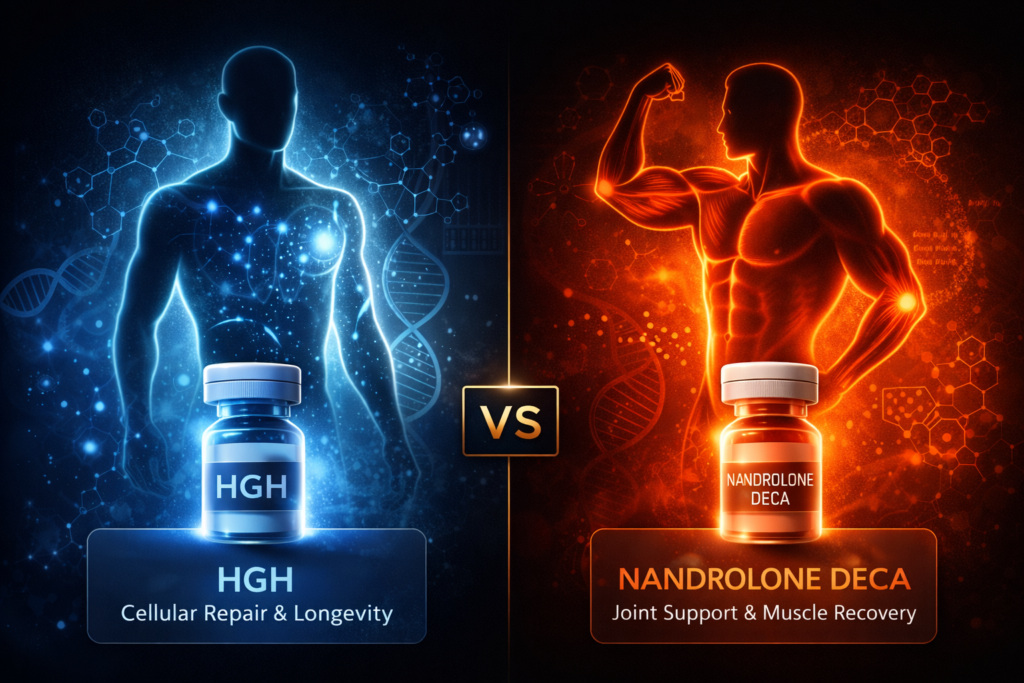
At MultiGen Wellness, many patients come to us seeking improved strength, recovery, energy, body composition, and longevity. Two therapies that are sometimes discussed in the optimization and regenerative-medicine world are Human Growth Hormone (HGH) and Nandrolone Decanoate (often referred to as “Deca”).
Although they are sometimes mentioned in the same conversation, they are very different medications, work through different biological pathways, and are used for very different reasons under medical supervision.
This article explains:
- how HGH and Nandrolone function in the body
- what each one is typically used for
- strengths and weaknesses of both
- whether a patient would choose one or the other
- when they may (or may not) be appropriate
Our goal is to provide clear, clinical-level education — not hype, not gym-culture speculation, and not unsafe usage guidance.
What is HGH? (Human Growth Hormone)
HGH is a peptide hormone naturally produced by the pituitary gland. It plays a key role in:
- cellular repair
- tissue regeneration
- fat metabolism
- bone density
- sleep quality
- collagen formation
- insulin-like growth factor-1 (IGF-1) production
In medical settings, HGH therapy is typically considered when there is:
- true growth hormone deficiency
- age-related hormone decline with confirmed low IGF-1
- delayed recovery, chronic fatigue, or muscle wasting in specific cases
Modern optimization medicine uses HGH far more conservatively today than in the past, and typically at age-appropriate physiologic dosing — not performance-enhancement levels.
Potential Benefits of HGH
Patients who are clinically appropriate candidates may experience:
- improved sleep and recovery
- better skin elasticity and collagen tone
- increased fat metabolism
- enhanced tendon and soft-tissue repair
- mild improvements in strength and performance
- improved cognitive resilience and mood stability
HGH’s strongest area of support is cellular repair and anti-aging physiology, rather than pure muscle-building.
Limitations & Risks of HGH
HGH does not typically produce rapid strength or muscle mass gains.
Possible downsides include:
- water retention or bloating
- increased blood sugar or insulin resistance in some patients
- joint stiffness or carpal tunnel-like symptoms
- elevated IGF-1 levels if overdosed
- increased cost compared to most therapies
HGH is a long-arc therapy — it works slowly, gradually, and subtlely over time.
Patients who expect dramatic anabolic results from HGH are often disappointed — because that’s not its real physiological role.
What is Nandrolone Decanoate (Deca)?
Nandrolone Decanoate is an anabolic derivative originally developed for:
- muscle wasting
- trauma and injury recovery
- osteoporosis
- chronic degeneration and inflammation conditions
In optimization-medicine use, it is most often used for:
- joint comfort and lubrication
- tendon / ligament stress recovery
- increasing training reliability
- restoring lost lean body mass
- soft-tissue repair in aging patients
Unlike testosterone — which is a broad male hormone replacement — Nandrolone is highly specific in effect, especially for connective-tissue support.
Potential Benefits of Nandrolone
When medically appropriate, patients may experience:
- improved joint comfort and movement quality
- increased lean muscle strength and density
- reduced tendon irritation and joint grinding
- improved muscular endurance and recovery
- increased stability for older patients with chronic pain
- improved ability to train consistently without flare-ups
One of Nandrolone’s most valuable clinical strengths is that it often allows patients to return to functional activity, where pain previously limited movement.
Movement improves metabolism, mood, insulin sensitivity, and longevity — meaning the secondary benefits can be wide-reaching.
Limitations & Risks of Nandrolone
Potential considerations include:
- estrogen or progesterone-like side-effects if not monitored correctly
- suppression of natural testosterone production in men without HCG
- acne, increased oil production, or mood sensitivity in some patients
- not appropriate for every health profile
- must be cycled or clinically supervised
- requires regular labs
Unlike HGH, Nandrolone can feel noticeable and fast-acting, which is why it must be used with structural oversight, not as a casual enhancement drug.
HGH vs. Nandrolone — They Are NOT Interchangeable
Even though both may affect:
- recovery
- muscle support
- aging physiology
They behave differently.
HGH is best described as:
“A cellular repair and longevity-support hormone.”
Nandrolone is best described as:
“A joint-support, strength-support, and functional-movement therapy.”
One is not “better” than the other — they simply serve different clinical objectives.
Do You Choose One or the Other?
In most cases, the decision depends on the primary goal of treatment.
Someone may be a stronger candidate for HGH if their primary goals are:
- slower aging
- collagen and cellular repair
- metabolic health
- improved sleep, recovery, and stress resilience
- true, lab-verified growth hormone deficiency
HGH shines most in long-term resilience and anti-aging pathways.
Someone may be a stronger candidate for Nandrolone if their goals are:
- joint pain relief
- degenerative joint stiffness
- training-related tendon irritation
- age-related muscle loss
- return to physical movement / activity
- soft-tissue repair
Nandrolone shines most in functional strength and mobility recovery.
Can Someone Use Both?
Sometimes — yes.
However, doing so requires:
- appropriate medical screening
- baseline & follow-up labs
- cardiovascular risk factor evaluation
- age, family history, and hormone context review
In optimization medicine, the best approach is:
not “more therapy,” but the right therapy for the right patient.
Many people don’t need both.
Some people don’t need either.
And a smaller subset benefit from a carefully programmed combination under continuous monitoring.
Our Clinical Perspective at MultiGen Wellness
We don’t prescribe based on trends, gym culture, or “what someone heard works.”
We evaluate:
- symptoms
- movement quality & joint health
- training tolerance
- lab markers
- hormone baselines
- age and metabolic profile
- patient goals
- long-term safety considerations
Then therapy decisions are made intentionally, not reactively.
Every medication has strengths.
Every medication has limitations.
Our role is not to “push enhancement,” but to:
- restore function
- improve quality of life
- protect health longevity
- support men and women in aging well — strong, capable, and resilient
Thinking About Whether One of These Therapies Is Right for You?
We do not recommend HGH or Nandrolone blindly, casually, or as self-experimentation.
If you’re curious whether either therapy may be clinically appropriate for your situation, the right next step is a structured consultation.
We’ll review:
- your goals
- your medical background
- your lab work
- your structural and functional needs
And we’ll give you clear, honest guidance — even if the right answer is
“You don’t need this therapy.”