
Understanding SHBG, Free Testosterone, and True Male Optimization
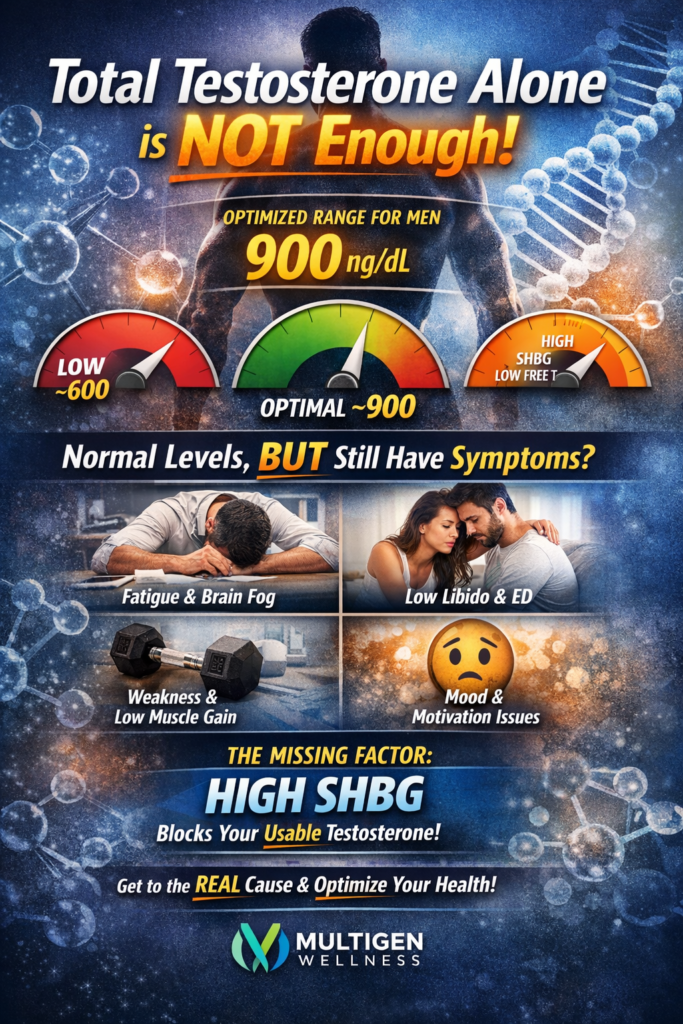
At MultiGen Wellness, we frequently see men who are told their testosterone levels are “normal,” yet they continue to experience fatigue, low libido, erectile dysfunction, brain fog, mood instability, and reduced motivation.
This disconnect usually occurs because testosterone was measured—but availability was not.
The Foundational Marker: Total Testosterone
Total Testosterone is the foundational starting point for any male hormone evaluation. It measures the total amount of testosterone circulating in the bloodstream.
However, Total Testosterone alone does not determine how much testosterone your tissues can actually use.
MultiGen Wellness Male Optimization Targets
For adult men, MultiGen Wellness evaluates testosterone using the following functional optimization ranges, not population averages:
- Low / Sub-optimal: ~600 ng/dL
- Optimized Functional Range: ~900 ng/dL
- Upper Clinical Ceiling (not a target): ~1,200 ng/dL
These ranges are used as clinical reference points, not guarantees of outcomes. Individual response, symptom resolution, and biochemical context always matter.
A man can test at 700–800 ng/dL and still experience symptoms if testosterone is not biologically available.
The Missing Variable: SHBG
Sex Hormone Binding Globulin (SHBG) is a liver-produced protein that binds testosterone in the bloodstream.
When SHBG levels rise:
- More testosterone becomes bound
- Bound testosterone is inactive
- Tissue-level androgen signaling decreases
Real-World Example
A man may have:
- Total Testosterone: 700 ng/dL
- SHBG: Elevated
Functionally, this may result in only 300–400 ng/dL worth of usable testosterone, despite labs appearing “normal.”
This is one of the most common reasons men are symptomatic despite acceptable total values.
Free vs Bound Testosterone
Testosterone exists in three states:
- SHBG-bound testosterone (biologically inactive)
- Albumin-bound testosterone (partially available)
- Free Testosterone (biologically active)
Free Testosterone is responsible for:
- Libido and erectile quality
- Energy and motivation
- Muscle strength and recovery
- Cognitive clarity
- Mood stability
Elevated SHBG reduces Free Testosterone even when Total Testosterone is adequate.
Common Causes of Elevated SHBG
Elevated SHBG may be influenced by:
- Aging
- Chronic stress
- Caloric restriction
- Thyroid signaling
- Certain medications
- Liver metabolic signaling
- Genetic factors
This explains why symptom presentation varies widely between individuals with similar lab results.
Symptoms of High SHBG
Men with high SHBG often report:
- Fatigue despite “normal” testosterone labs
- Erectile dysfunction or reduced libido
- Difficulty building or maintaining muscle
- Brain fog or lack of motivation
- Emotional flatness or reduced drive
These symptoms are often misattributed when SHBG is not evaluated.
Why Optimization Requires More Than One Number
At MultiGen Wellness, Total Testosterone is treated as a baseline reference, not a diagnostic conclusion.
Proper evaluation considers:
- Total Testosterone
- SHBG
- Free or Calculated Free Testosterone
- Clinical symptoms
- Individual metabolic context
Optimization focuses on functional hormone signaling, not chasing isolated numbers.
Treatment Considerations When SHBG Is Elevated
When SHBG is high, clinical strategies may differ and can include:
- Adjusting testosterone delivery methods
- Modifying dosing strategies
- Supporting metabolic pathways
- Addressing lifestyle contributors
- Selecting approaches that improve bioavailability, not just total levels
This is why generic hormone protocols often fail to resolve symptoms.
Key Takeaway
- Total Testosterone is foundational — but incomplete
- SHBG determines how much testosterone your body can use
- MultiGen Wellness male optimization targets aim for ~900 ng/dL functional range
- High SHBG can cause symptoms even with “normal” labs
- True optimization is symptom-guided and context-driven
If you have been told your testosterone is normal but do not feel normal, the issue may not be production — it may be availability.