
How the Meridian Loop Works
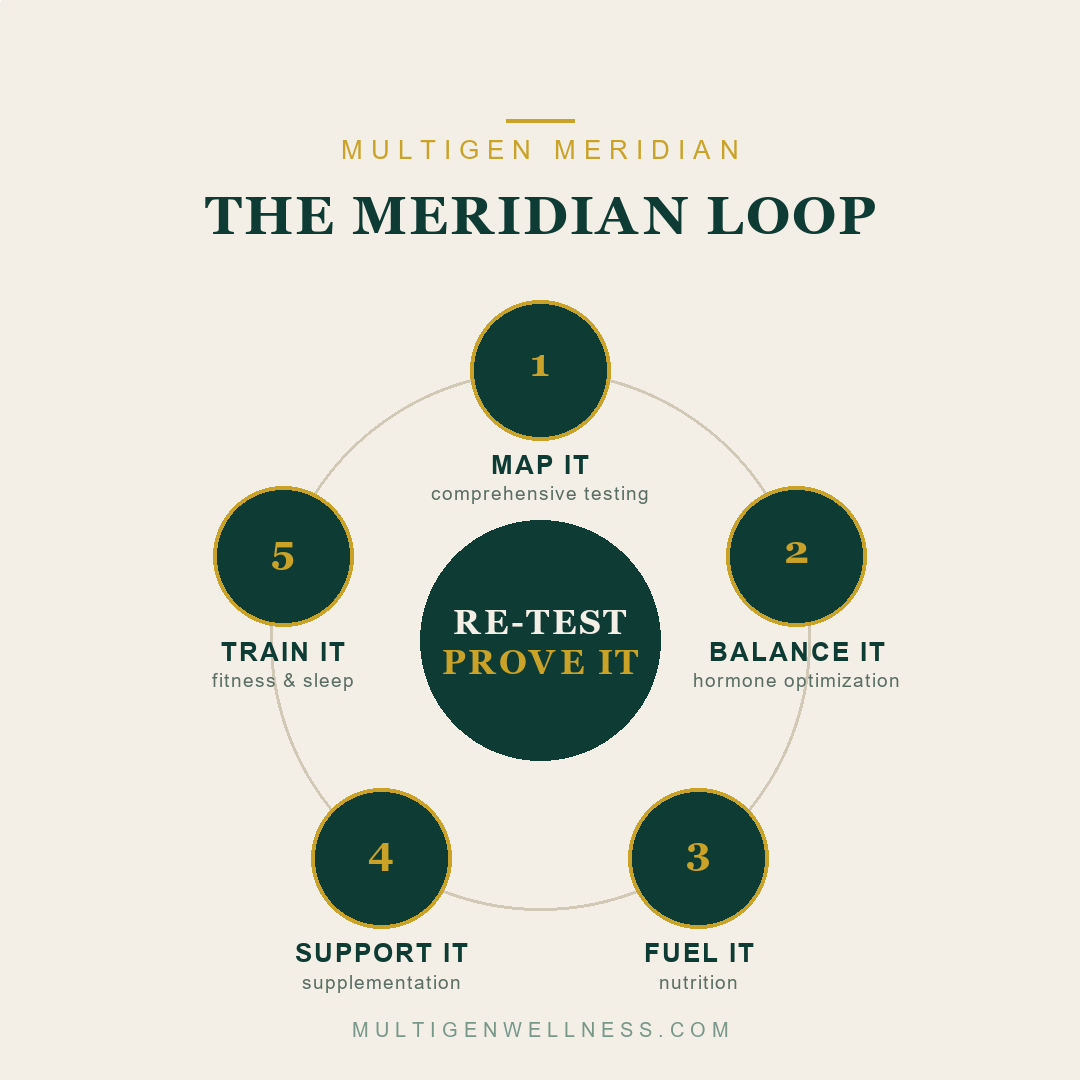
Five pillars feeding a sixth step: map, balance, fuel, support, train — then re-test to prove it. Here is the patient journey, step by step.
Start your intake
Telehealth · 1-800-259-0015
Most hormone programs stop at a prescription and hope the rest sorts itself out. The Meridian Loop is built the opposite way: as one connected, governed cycle that maps your whole system, optimizes hormones under clinical guidance, dials in nutrition, supplementation, and training, and then re-tests to prove it worked.
For the bigger-picture philosophy, start with integrative hormone health; for the full testing menu, see comprehensive hormone testing.
One connected cycle
Five pillars that feed a sixth step where we prove it with data — then the loop runs again.
Map it
Everything begins with data. Rather than a single testosterone or TSH reading, your clinician orders a comprehensive, individualized panel spanning sex hormones, thyroid, adrenal rhythm, metabolic and insulin markers, inflammation, micronutrient status, and a safety baseline.
- You complete a telehealth intake covering symptoms, history, and goals.
- Labs are drawn (standard collection), then interpreted in context — free testosterone read against SHBG, a full thyroid picture rather than TSH alone.
- Your provider walks you through what the results mean, including where a “normal” value may still be worth addressing.
Balance it
With a clear picture in hand, your clinician builds a hormone plan individualized to you — for men and for women. Whether that involves hormone optimization, root-cause work, or a hybrid is a clinical decision, not a template.
- Dosing, targets, and cadence are set by a licensed provider based on your results, never a one-size-fits-all protocol.
- When hormone therapy is part of the plan, established endocrine safety monitoring is built in — hematocrit, PSA for men, and estradiol where relevant, at baseline and on schedule.
- The aim is not to chase a single number but to support how you feel and function, safely.
Fuel it
Nutrition is treated as a lever on hormone and metabolic health, not a side note — and it is built around your labs rather than a generic diet.
- Adequate protein to support lean mass, satiety, and body-composition goals.
- Blood-sugar control by moderating refined carbohydrate and sugar, which helps maintain insulin sensitivity.
- Adequate dietary fat, since very-low-fat eating is associated with modest reductions in testosterone in men.
- Anti-inflammatory, Mediterranean-style patterns rich in olive oil, fatty fish, vegetables, and whole foods.
Support it
Targeted supplementation is offered as education, not hype, and it follows a simple principle: repletion mainly helps when a deficiency actually exists — which is why we test first.
- Nutrients such as zinc, magnesium, and vitamin D are cofactors for hormone production, and correcting a real deficiency can matter.
- Evidence is presented plainly, including where it is mixed — the effect of vitamin D on testosterone is inconclusive, particularly when baseline levels are already adequate.
- We do not publish specific doses or “stacks,” and we do not claim supplements treat hormone deficiency.
Train it
Physical activity and recovery are genuine physiological levers, and recovery is part of the protocol, not an afterthought.
- Resistance training using large muscle groups builds body-composition and insulin-sensitivity improvements over time.
- Zone-2 cardio supports mitochondrial and metabolic health, recovery, and sleep.
- Sleep is protected deliberately, since poor sleep is a well-documented suppressor of testosterone and growth hormone.
- Avoiding overtraining matters too; chronic excess without recovery can work against you.
Prove it — the re-test loop
This is what makes it a loop instead of a one-time prescription. On a clinician-set schedule, we re-test the markers that matter, review what actually moved, and adjust.
Your provider compares new results to your baseline, discusses how you feel alongside the numbers, and refines any pillar that needs it — with safety labs continuing throughout. Over time, that cycle is how the plan stays matched to your body instead of drifting.
Frequently asked questions
How long does one loop take?
It varies by person and by what your plan involves. A typical cycle includes an intake and baseline testing, a period on your connected plan, and a scheduled re-test. Your clinician sets the cadence based on your results and goals.
Is this only for men, or for women too?
Both. The Meridian Loop is a dual-sex program, with the Balance it step individualized for men and for women, including those navigating perimenopause and menopause.
Do I have to do all five pillars?
The pillars are designed to work together, because hormones, nutrition, supplementation, and training influence one another. Your clinician tailors the emphasis to what your data and life actually call for.
What makes re-testing so central?
Because it is the only honest way to know whether the plan is working. Rather than promising a result, we commit to measuring, then re-measuring, and adjusting based on what the data shows.
Is hormone therapy always part of the plan?
No. Whether hormone optimization is appropriate is a clinical decision. For some people the plan leans more on root-cause and lifestyle work; for others it is a hybrid. When therapy is included, standard safety monitoring comes with it.
Is everything done by telehealth?
Yes, the program is built for telehealth, with lab collection handled through standard providers and clinician visits conducted virtually.
Ready to run your first loop?
Begin your intake online, or call to talk through whether the Meridian Loop is right for you.
Start your intake
Or call 1-800-259-0015
This page is for educational purposes only and is not medical advice. It does not diagnose, treat, or guarantee any outcome. Your plan, testing, and any treatment must be directed by a licensed clinician who knows your individual history.
Related reading
Explore how each part of the hormone system connects to the whole.